
Getting connected is the first thing you will need to do to stay in contact with friends and family in Australia and back at home.
The best mobile phone deal for you is the one that allows you to do the things you want to do at the lowest cost. Understanding all your choices means you will get the best deal.
Work out what option is best for you
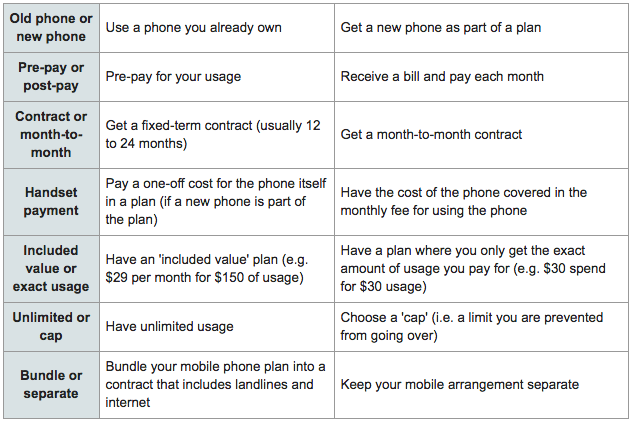
Plans and contracts
A ‘mobile phone plan’ is what a mobile service provider will provide you with, how the provider will charge you for using your phone, and how you will pay.
Within each plan, there is a range of services that will be charged in different ways. Understanding how your phone will be charged and how costs can be added to your bill will help you choose the best plan. For example, if you go over your monthly data cap, you may be charged for extra data usage.
Once you decide on a plan that suits you, you sign a ‘contract’. This is a legal agreement saying that you accept everything that’s described in the plan.
Pre-paid or post-paid
‘Pre-paid’ means you will use a mobile phone that you already own and pay in advance for using your phone on a mobile service provider’s network – that is, you buy credit and use it up over a certain period (such as a month or fortnight). When your credit is used up, you can receive calls, but can’t make them. Nor can you use data or send text messages. You have to buy more credit to make calls, use data or send texts with your phone. Sometimes, you lose your remaining credit if you don’t use it all within your specified time period.
Post-paid means you receive a bill at the end of each month that details how much you’ve spent and how much you need to pay. If you sign up for a post-paid plan, you’ll may be locked in for a certain amount of time (usually 12 or 24 months).
Included value
‘Included value’ means everything you get for your regular monthly payment. ‘Excluded value’ is anything you have to pay extra for. For example, 1300 and 1800 numbers are part of the ‘included value’ in some plans but not in others.
Smart Tip: If a plan includes a ‘free’ mobile phone handset, you’ll still end up paying for it one way or another. The cost is usually included in the plan’s monthly fee.
Allowance or limit
An ‘allowance’ is one part of your included value. For example, if you choose a plan that costs $50 a month, it may give you a $300 ‘allowance’ for calls and texts each month. Your allowance is sometimes called your ‘limit’. Some plans offer unlimited value, meaning you can make as many calls, send as many texts and use as much data as you like.
Ask your provider what happens when you reach your limit – that’s really important, as you could be charged a lot more.
Data
‘Data’ includes internet use, emails, live video chat, app updates, downloads and sending pictures in a text message (MMS).
Data does not include texting (SMS), voice calls, listening to voice messages, or taking photos.
Here are a few examples of data use and how many megabytes (MB) they use up:
- Watching a one-minute video online (about 5 MB)
- Downloading a TV program (about 350 MB)
- A one-hour Skype video chat (about 170 MB)
Wi-Fi vs. 4G
For data, it’s often cheaper to use your mobile phone with wi-fi than to access the internet on your mobile network (using mobile broadband such as 4G). That’s because data charges using a mobile network are usually higher than for other forms of internet connection, such as your home broadband.
Find the closest Free Wi-Fi Spots in your City.
